




Why Modernist Seating Made Its Frame Visible

Written by Charlotte Bruno
Design Editor at Madorne
In some upholstered chairs, the frame disappears beneath fabric and padding. In others, an exposed metal outline sits around the cushions, making the relationship between support and softness part of the design. That contrast is one reason modernist seating remains so visually distinctive.
Furniture often grouped under “Le Corbusier” should also be understood as collaborative work. The original Grand Confort designs are credited to Le Corbusier, Pierre Jeanneret and Charlotte Perriand. Looking closely at the frame-and-cushion relationship gives a more useful understanding than reducing the furniture to black leather and shiny metal.
Start with the collaboration, not one famous name
Cassina credits the original 2 Fauteuil Grand Confort, petit modèle to Le Corbusier, Pierre Jeanneret and Charlotte Perriand, 1928. Keeping all three names in view matters: a popular shorthand should not erase the credited collaborators.
Historical authorship and current manufacture are separate questions. A contemporary piece may refer to the visual language of a historical design without being made by its authorized manufacturer. Its current materials, dimensions and construction should be described on their own terms.
A familiar silhouette is not a complete attribution
A tubular frame appears in several different chair types. Some support separate cushions; others hold a sling seat, strap arms or a different back arrangement. Do not identify every polished-frame chair as a Grand Confort merely because the metal and upholstery colors look familiar.
The distinction is visible when you look at the seat and arms rather than only the outline. That is also why a historical label should be checked against the image and specification, not repeated uncritically.
Read the external frame as a line around soft volumes
In a frame-and-cushion composition, two visual systems operate together. The metal establishes thin lines, corners and reflections. The upholstery establishes larger volumes, softer edges and a different response to light. The furniture’s character comes from their relationship.
Look at the front and side together. Which parts of the frame remain visible beside the arms? How does the seat sit within the surrounding outline? Where do the cushions meet, and where is there a gap? These observations help explain the form without pretending that a photograph reveals every structural detail.

The Modulor Grand 28 lounge chair provides a current example of this contrast. Its listing describes an external steel cage, separate cushions and full-grain aniline leather. It is an independently manufactured piece, not an original historical edition.
Visibility is not the same as proof of strength
An exposed frame makes some connections and proportions easier to see. It does not, by itself, prove a particular load capacity or manufacturing quality. A bright reflection cannot establish tube thickness, the quality of a weld or how a cushion is supported internally.
Likewise, a listed steel grade should not be treated as evidence that every other detail matches a historical original. Read documented construction alongside the visible form, and avoid equating a shared material family with identical manufacture.
Understand why proportion changes the experience
A broad cushion and a narrow cushion can occupy the same visual system while suggesting different kinds of sitting. Arm volume, back height, seat depth and the relationship to the floor all influence how enclosed or open a chair feels.
The distinction between petit and grand model names is therefore not permission to assume dimensions. Read the current product’s actual figures. The Modulor Grand chair lists an overall width of 35.8 inches, depth of 27.5 inches and height of 27.2 inches, with a seat height of 15.4 inches.
Compare usable seating, not just outer width
Large arms can consume part of the overall footprint. A wide frame does not necessarily mean an equally wide seat, and a low overall back does not explain the back angle. Where usable seat measurements are absent, request them rather than deriving them from a front photograph.
Comfort is personal and depends on geometry as well as cushion feel. Calling an entire family of historical-looking chairs “firm,” “ergonomic” or “comfortable for hours” overstates what a silhouette can tell you.
The same visible-frame language can use different upholstery
Leather, faux leather and textiles can create different surface effects around a similar polished outline. They are not interchangeable maintenance categories. Animal leather finish, synthetic coating and fabric construction each need to be identified separately.

The Modulor Petit 28 two-seater lists vegan-friendly microfiber faux leather and a polished steel frame. Its overall dimensions are 51.2 inches wide, 27.6 inches deep and 26.8 inches high, with a listed seat height of 17.3 inches. Those are current product figures, not measurements of an original edition.
Keep care instructions attached to the actual material
Do not apply an animal-leather conditioner to synthetic upholstery merely because both pieces appear in the same design-inspired range. Similarly, frame cleaner should not be sprayed across cushions. Our leather furniture care guide explains why identifying the finish comes before choosing a treatment.
Use polished metal as contrast rather than a decorating theme
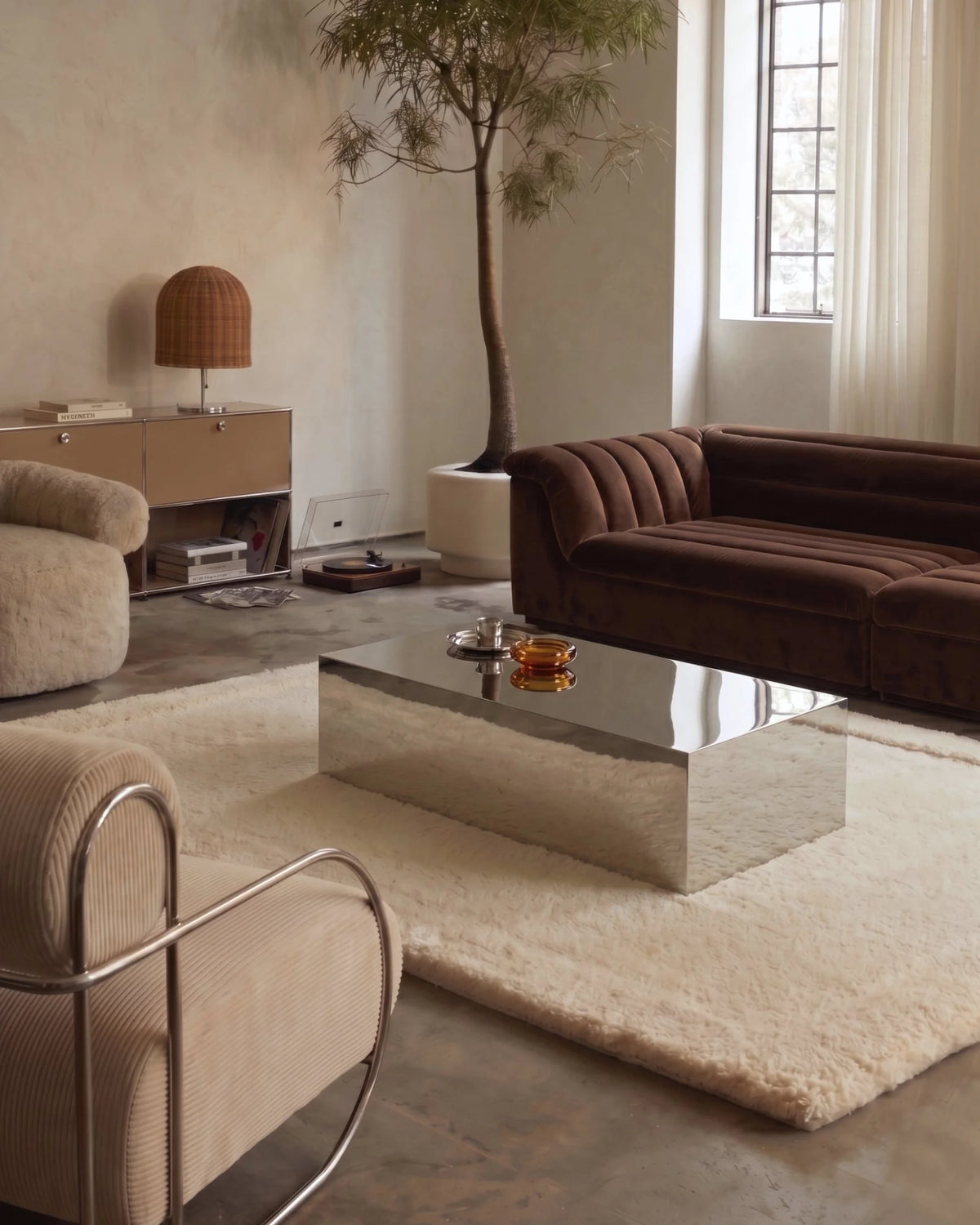
A visible polished frame can work against warm timber, a textured rug or a quiet painted wall. The contrast gives the line room to read. The surrounding room does not need to repeat chrome on every table, lamp and cabinet handle.
Consider reflections from the position where people actually sit. A bright window may create a strong highlight on a frame, while evening lamps produce a different effect. Metal is not visually static; it reflects the room you place around it.
Give the outline room to remain visible
Placing several strong frames tightly together can make their individual forms harder to read. Check the composition from the entrance and then test practical access around the seats. Empty space should serve circulation or the clarity of the grouping, not be preserved solely for a photograph.
Our guide to planning a living room around its uses develops that layout step. A coherent room can combine exposed-frame seating with a softer contemporary sofa rather than assembling a complete period set.
What this design language teaches us to notice
Look for the relationship between outline and volume, between structural specification and visible appearance, and between historical authorship and current product identity. These distinctions make design references more informative and less misleading.
When exploring furniture inspired by this modernist design language, use historical context to understand the forms, then use the current listing to assess the actual piece. Inspiration is context, not a substitute for its materials or measurements.
Visible-frame modernist seating: common questions
Who is credited with the original Grand Confort design?
The original design is credited to Le Corbusier, Pierre Jeanneret and Charlotte Perriand. The shortened “Le Corbusier” label should not obscure that collaboration.
Is every tubular-frame chair an LC2-style cushion chair?
No. Sling seats, strap arms and separate cushion systems are different arrangements. Identify the form from the complete image and specification, not the polished metal alone.
Does exposed steel make a chair more durable?
Not automatically. Material, joints, support and manufacture all matter. An exposed outline is a design feature, not a complete structural test.
Can I borrow original-edition dimensions for an inspired product?
No. Plan with the exact current piece’s listed dimensions and ask for any missing measurements. Shared visual references do not establish identical geometry.
Read more

A finish-first guide to dusting, spills and maintenance, with clear advice on when to stop and ask for specialist help.

Plan circulation, seating and material relationships before choosing decorative details for a room that works every day.