



How to Match an Ottoman’s Height and Footprint to a Lounge Chair

Written by Charlotte Bruno
Design Editor at Madorne
A lounge chair and ottoman should work together in more ways than appearance. The footrest’s height, usable surface, distance from the seat and footprint all affect how you use the pair. A shared collection name is a useful starting point, not a promise that every user will find the same position comfortable.
First check the pieces as specified, then test the resting position and the route around them. This guide focuses on matching dimensions and use, rather than treating an ottoman as an automatic accessory to every chair.
Compare seat height with the ottoman’s top height
Use the chair’s seat height, not the back or arm height. For the ottoman, use floor-to-top height. If you already own the chair, notice how its seat changes when occupied. A nominal measurement does not fully describe a soft cushion under weight.
The top of a footrest can also compress. Compare the actual resting surfaces where possible rather than assuming two upholstered pieces behave identically.

Use the difference as a comparison, not a prescription
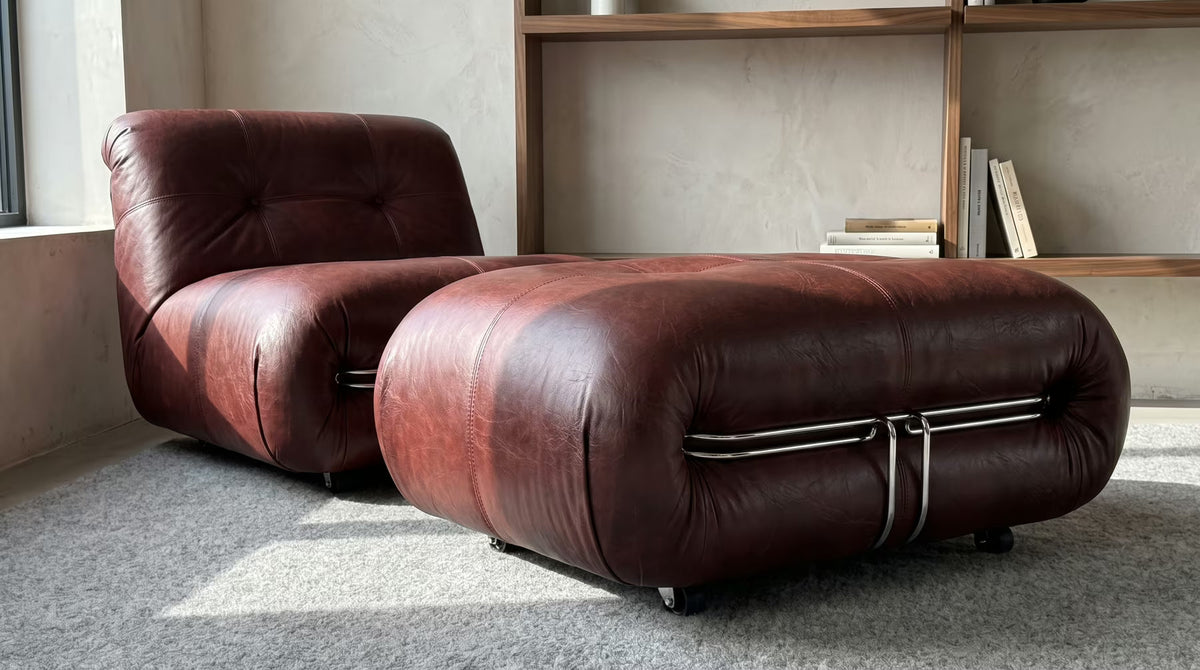
The Soria 69 lounge chair lists a seat height of 17.7 inches. The Soria 69 ottoman lists an overall top height of 16.9 inches. The footrest is therefore nominally 0.8 inches lower.
That figure helps describe the pair; it does not prove the resting position suits everyone. Back angle, leg length, cushion behavior and distance still matter. Avoid choosing a footrest from one universal height rule.
Check the usable surface and the full footprint
The ottoman’s outer dimensions include its edges, upholstery volume and frame. Check where your feet or lower legs would rest, and whether the intended position is appropriate for the piece. A decorative outline does not establish a comfortable usable surface.
The Soria ottoman lists a width of 38.6 inches and depth of 34.6 inches. The chair lists an overall width of 37.4 inches and depth of 42.1 inches. The footrest is not necessarily a smaller object just because it sits lower.

Measure the pair as an arrangement
If the chair and ottoman are placed directly in line without footprint overlap, adding their listed depths gives a basic 76.7-inch planning length before the gap between them. This is only a rectangular estimate, not a verified installed dimension or a recommended gap.
Angling the chair, offsetting the ottoman or changing the position can alter the bounding area. Mark the complete arrangement on the floor, then add the approach and side surface.
Test distance from your normal sitting position
Sit as you normally would in the chair and use a stable temporary footrest appropriate for the test. Do not create a precarious stack. Notice whether you can rest comfortably without sliding forward out of the back support or reaching too far with your legs.
Move the footrest a little at a time, then check how you get out of the chair. A position that feels pleasant while resting may obstruct the place where you put your feet before standing.
Keep an approach route beside the pair
A chair-and-ottoman grouping needs access around its combined footprint. Do not place the footrest in the only passage because it can theoretically be moved. Plan where it belongs during ordinary use and where it goes if temporarily set aside.
Our guide to planning a complete reading corner includes the chair, footrest, reachable table and walking route. Use that complete plan rather than treating the ottoman as free floor space.
Coordinate finish without assuming identical materials
Check the exact upholstery variant on both products. A family name or color description does not prove the same composition, finish or shade. The Soria ottoman listing gives a particular composition for its white bouclé; that does not establish the composition of its leather-like options.
If matching matters, request confirmation of the pair’s available finishes and any expected variation. Compare samples in the room’s light where possible. An attractive coordinated pair can also use deliberate contrast, provided the contrast feels intentional.
Separate texture from maintenance
A footrest can receive different contact from the chair, including clothing and objects placed on it. Follow each selected upholstery’s approved care method. Do not apply a conditioner to a vegan material or assume a soft textured cover can be washed.
Our guide to comparing upholstery fabrics separates texture, composition and maintenance. The same approach helps when choosing a chair and footrest together.
Use the ottoman only for its stated role
Some ottomans may be designed for additional seating; others are primarily footrests. Confirm the actual model’s intended use and load guidance before relying on it as a guest seat. A broad upholstered top is not a structural rating.
Likewise, an ottoman is not automatically a stable coffee table. Do not place a hot drink on a soft surface or use an improvised tray as a guarantee against tipping. Choose a separate suitable surface where needed.
Distinguish a companion piece from universal compatibility
An independently movable ottoman does not require the same connection compatibility as a sofa module, but it still needs to suit the chair’s geometry and the room. A matching visual language is a design choice, not a mechanical compatibility promise.
If what you really need is a single extended seat, compare the complete footprint with the options in our chaise placement guide. Neither solution is automatically more space-efficient.
Make the final check before adding the footrest
Record chair seat height, ottoman top height, both footprints, selected upholstery and intended use. Add the actual distance and access to your plan. If a measurement or material is absent, ask rather than filling it in from a photograph.
When exploring ottomans and footrests, shortlist pieces that serve the seat you use and the space you have. A thoughtful pairing should make the chair more useful, not simply make the order larger.
Ottoman pairing questions
Should the ottoman be lower than the seat?
A lower surface may work, but there is no universal difference that guarantees comfort. Test the actual resting position and cushion behavior.
Is a matching ottoman always smaller than its chair?
No. Check the outer width and depth. A low piece can have a substantial footprint.
Can I use it as extra seating?
Only where the specific model’s intended use and guidance permit that role. Do not infer a seating rating from appearance.
What is easy to overlook?
The approach beside the pair and the place where your feet land when standing. The furniture must work beyond the resting position.
Read more
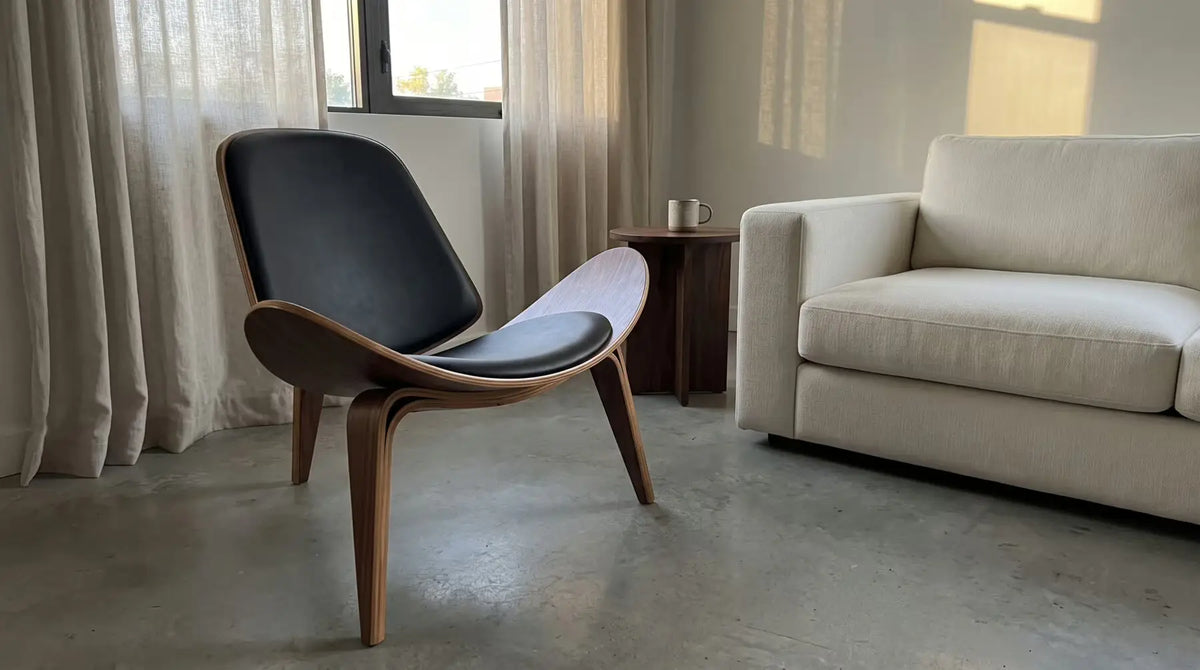
Balance a sculptural chair and a linear sofa through silhouettes, one material connection, actual footprints and everyday viewpoints.
Balance a sculptural chair and a linear sofa through silhouettes, one material connection, actual footprints and everyday viewpoints.