




How to Choose a Modular Sofa for a Room That May Change

Written by Charlotte Bruno
Design Editor at Madorne
A modular sofa is useful when its permitted configurations solve a real need: a different room after a move, a change in the seating group, or a larger arrangement built from compatible elements. The word “modular” alone does not guarantee that every piece stands independently, can be mirrored or will remain available to buy later.
Before choosing a system, define the change you want it to accommodate. Then check the specific modules, connections and dimensions that make that change possible. A clear plan for two useful layouts is more valuable than a promise of unlimited flexibility.
Ask what can actually change in the sofa system
“Sectional” and “modular” are used in overlapping ways. Some sectional arrangements can be reconfigured; some modular products have limits imposed by arms, corners or connections. Do not rely on a rigid vocabulary rule in place of the actual specification.
Ask which units are available, which sides are finished, whether arms are fixed, and which configurations the supplier permits. A piece that forms an attractive corner within a sofa may not be intended as a separate chair. An armless unit does not necessarily have universal connection points.
Separate rearrangement, expansion and replacement
Rearrangement means changing the position of pieces you already own. Expansion means obtaining additional compatible pieces. Replacement means being able to replace a damaged module or cover. These are three different capabilities, and a product may support one without guaranteeing the others.
If future expansion matters, confirm individual module availability and compatibility with the current production. Do not assume a selected fabric or connector will remain unchanged indefinitely. Keep the exact order specification so a later enquiry can identify the system and finish.
Plan today’s configuration and one realistic alternative
Draw the current room, mark doorways, heating, storage and the routes people use. Then place the full selected configuration on that plan. Check the occupied arrangement, not only the outline of an empty sofa.
Next, draw the specific alternative you expect to need. It might be a straight arrangement after a move or a chaise on a different side. Label each element in both plans. If the second arrangement requires another arm, a different corner or a module that cannot stand alone, identify that before buying.
Use the assembled dimensions wherever available
Adding individual widths can produce a planning estimate, but overlap, connection spacing, arms and orientation may affect the finished footprint. Ask for an assembled dimensioned diagram rather than presenting a sum as a guaranteed configuration size.
Our guide to three low-seating layout plans shows how measured furniture footprints can support a straight, L-shaped or conversational arrangement. Its geometric planning examples should not be treated as proof that every sofa system has the same connections or permitted layouts.

Understand how the selected modules are secured
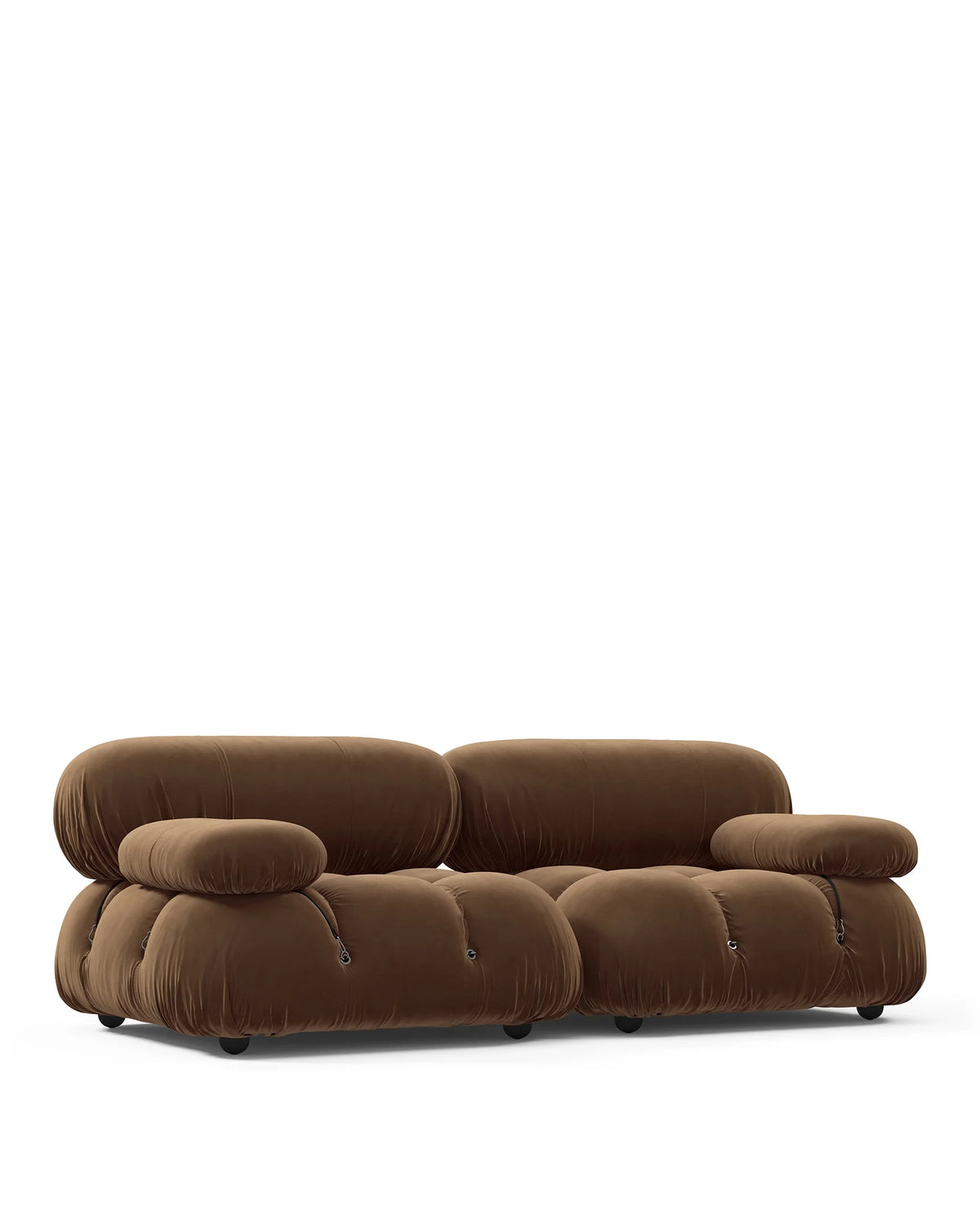
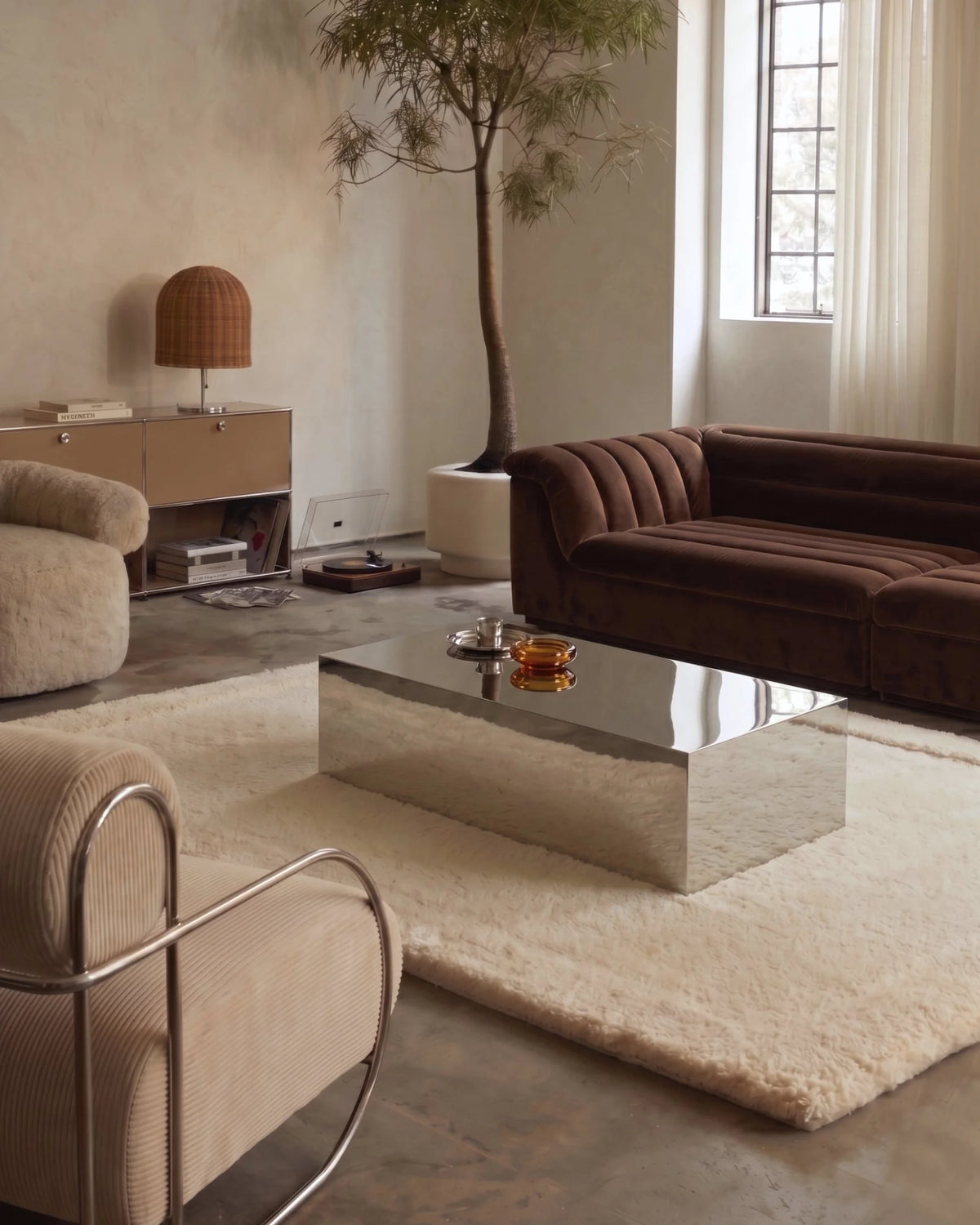
The Le Mur 72 old-gold velvet two-seater lists side buckles for arranging and securing individual modules. Its current overall dimensions are 81.8 inches wide and 40.6 inches deep, with a seat height of 15.7 inches.
Those details describe this product. They do not establish compatibility with another modular range or prove that all arrangements use identical buckle positions. Follow the supplier’s assembly and connection instructions for the actual modules.
Do not treat friction or improvised clips as a connection plan
Ask how the pieces should be joined and whether they are permitted to remain separate. Do not add unapproved hardware or assume a rug will keep elements in their intended positions. A comfortable-looking photo is not an assembly instruction.
If modules move unexpectedly during normal use, check the approved connection method and contact the supplier. Avoid improvised stress tests, sitting across an unsupported junction or applying lateral force to demonstrate stability.
A chaise changes the footprint, not just the seat count
A chaise element can add a resting surface while reducing the space available for circulation. It should be evaluated as part of the whole arrangement. “Two seats and a chaise” does not tell you the room size required.

The Tuft 05 armless chaise lists an overall width of 43 inches and depth of 59 inches. It is a separate example of a chaise-form element, not an accessory promised to connect to the Le Mur. Check its intended system and permitted use independently.
Confirm orientation from a diagram
If a chaise is sold as left or right, ask which viewpoint defines that label. If a system is described as reversible, confirm the actual process and any extra components required. Do not assume all modules can simply be mirrored.
Our guide to placing a chaise without blocking a route develops the access-side and footprint checks. It keeps the chaise’s room-planning role separate from the question of connection compatibility.
Compare usable seats and cushion geometry
Overall width includes more than the space available to sit. Arms, side volumes and corners may occupy part of it. Compare usable seat width, depth and back arrangement wherever the listing provides them; request missing figures rather than estimating from the product’s stated seat count.
For the Le Mur two-seater, the listing gives a 23.6-inch seat depth. That helps describe the selected seat, but it does not establish the geometry of every other module. A corner or chaise may have a different usable surface.
Check the whole group for the people who use it
A deep sofa may suit one user and make another want a different sitting position. Seat height, back angle, arm position and cushion feel work together. An upholstery sample cannot tell you the cushion’s support, just as a low silhouette cannot prove comfort.
Decide whether the group needs mostly lounging space, upright conversational places or a mix. A separate lounge chair can sometimes solve that mix more clearly than adding another deep sofa module.
Choose upholstery with future consistency in mind
If expansion is important, ask whether later modules can be supplied in the same upholstery and whether shade variation is possible between production batches. The original furniture may also change appearance through light and use, so a later piece should not be promised as an invisible match.
Read composition and approved care for the exact selected fabric. Removable-looking covers are not automatically washable, replaceable or available separately. Confirm those capabilities before making them part of the purchasing decision.
Our fabric comparison guide explains how texture, cleaning requirements and available test results should be assessed separately. Modular format does not make an upholstery easier to clean.
Check delivery and document the chosen system
Ask how many packages the configuration uses and request their dimensions for delivery planning. Furniture dimensions after assembly may differ from the packaged form. Doors, stairs, lift openings and turning space all need separate assessment.
Keep a record of module names, selected upholstery, connection instructions and the approved configuration diagram. When exploring modular sofa systems, compare this practical information alongside appearance. Flexibility is useful only when you know which changes the system actually supports.
Modular sofa planning: common questions
Can all modular sofa pieces be used separately?
No. Confirm finished sides, support, arms and permitted use for each unit. A system label does not establish standalone suitability.
Can I add a module several years later?
Possibly, but future supply, upholstery and connection compatibility should not be assumed. Ask about the current system and keep its specification.
Do separate module measurements guarantee the assembled size?
Not always. Connections and orientation can affect the result. Use a dimensioned assembled plan wherever available and label any arithmetic estimate as an estimate.
What is the most important question before buying?
Ask which specific change you want the sofa to support, then verify the modules and instructions that make it possible. That is a more reliable decision than choosing the system with the largest advertised number of layouts.
Read more

Measure the complete chair-and-ottoman footprint, protect circulation, and position your reading light and side table for a corner you will actually use.

Understand the relationship between curved timber, woven seating and chair proportions through Danish design references.